Notes on a Canvas from Les Puces de Saint-Ouen
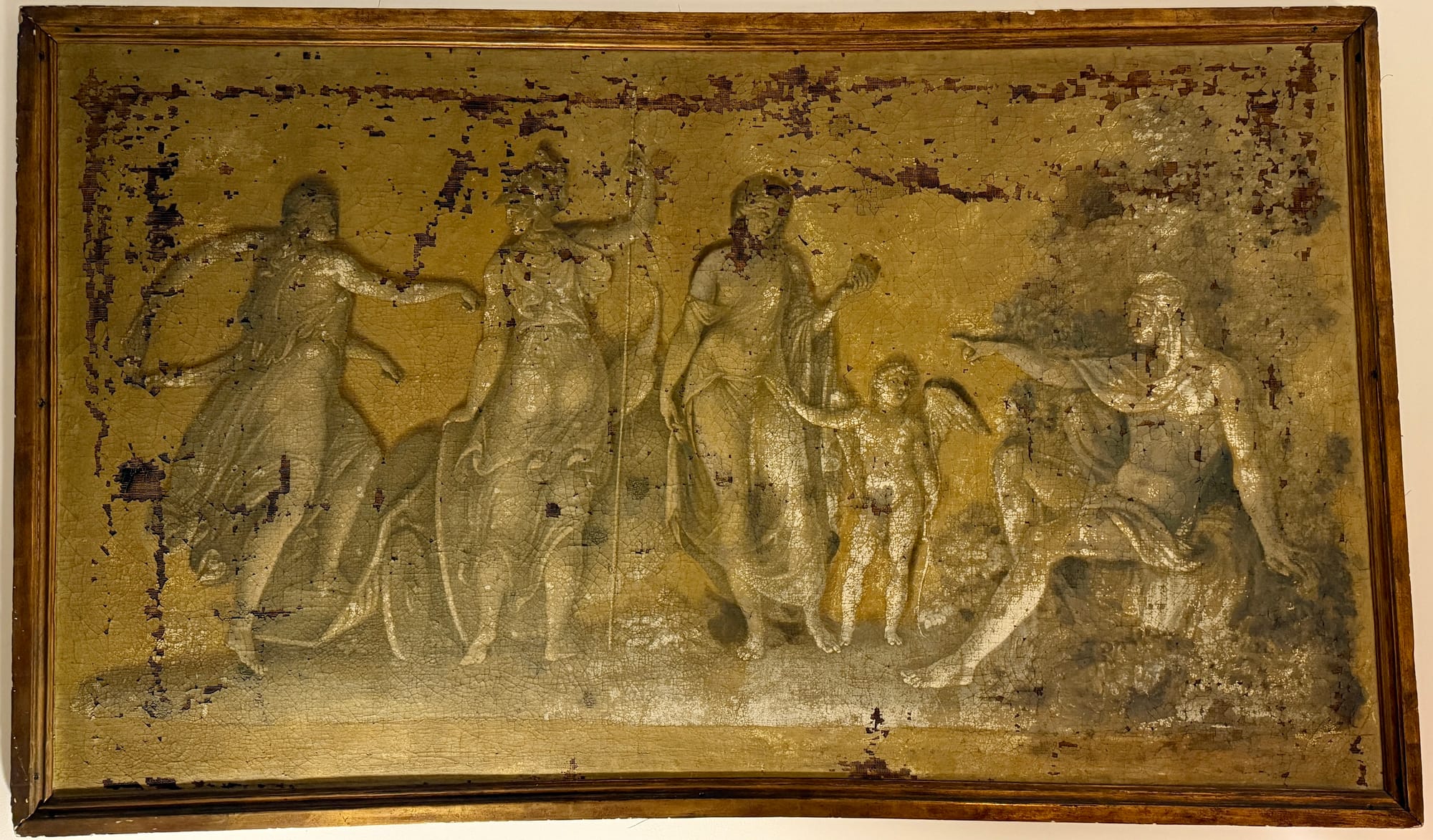
A grisaille depicting the Judgement of Paris
7 December, 2025 - ex cathedra
Although more affordable options exist in Paris to be sure - Leboncoin, the myriad brocantes, the perennial foires d’antiquaires - I’ve always taken particular pleasure in wandering les Puces de Saint-Ouen.
To wander les puces is to enter a peculiar world of maximal sensory engagement - the labyrinthian paths, the eclectic constellation of marchands, and, of course, the stands themselves: some dripping in Napoleon III ornament, others oozing 1960s americana; one dedicated to marble chimneypieces, another to gold giltwood mirrors meant to be hung above those very mantles; here a stack of syrian rugs, there bins of orphaned canvases and lithographs; wooden cartons of vinyls, heaps of bleu de travail, all scattered amongst the endless stands that look like a provincial brocante. Pépites abound.
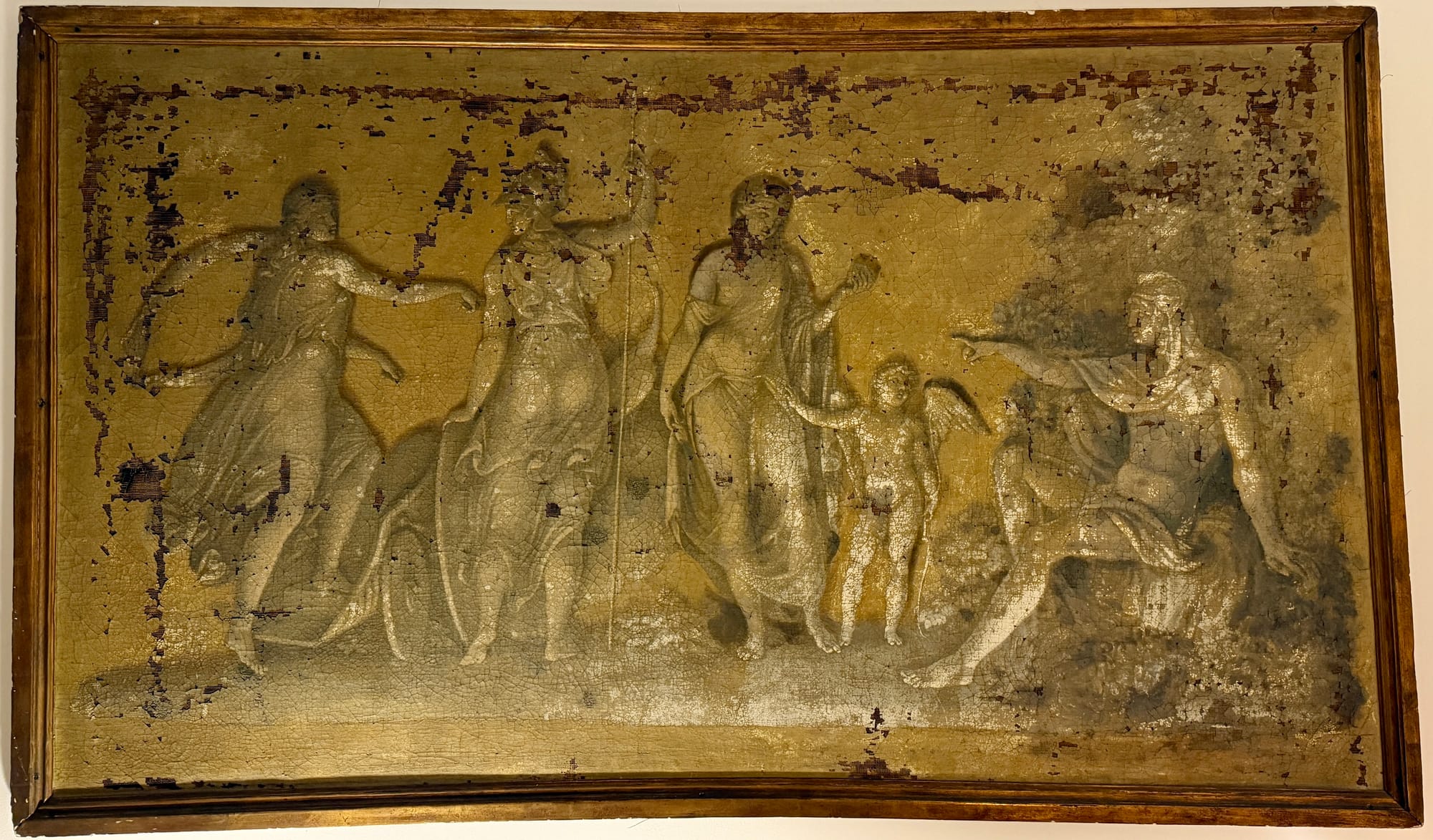
One Sunday shortly after arriving in Paris I was doing a circuit of les puces with a friend and we happened across a magnificent neoclassical canvas, roughly a meter by two, leaning blithely against a stall in Marché Vernaison. Its brown and grey paint was flaking off a coarse, almost burlack-like canvas, baking in a soft early-September sun. The frame was a peeling gold. The surface had a curious silver-gold patina. The canvas looked as if the chronophage itself had eaten away at it over the centuries in some dank parisian cave.
The scene on the canvas showed five figures: a seated, bare-chested man wearing what looked like a Phrygian cap [1], gesturing toward three ethereal women whose flowing movements made them seem mid-levitation. One held a rounded object beside a small Cupid. Another wore a corinthian warrior’s helmet. A third swept through the scene on a chariot, her garments drifting in an invisible breeze.
The marchand’s knowledge of the piece was cursory at best: neoclassical, probably 18th or 19th century, acquired from an estate in Neuilly-sur-Seine. I bought the canvas on impulse, dragged it back to the 6e, and hung it in the salon, content to see an empty wall filled.
Uncovering the Story
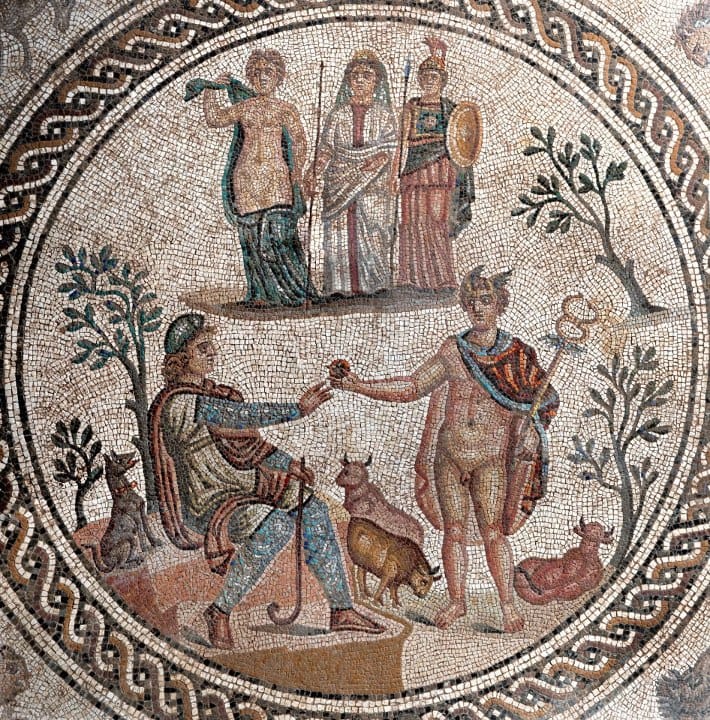
Months later, a friend who happens to be a trained classicist and art historian was visiting from Zurich. I asked him to take a look at the canvas. His initial remarks weren’t anything revelatory: Greek figures, mythological, Eros/Cupid, 18th or 19th century. He then pointed out that the three women looked like goddesses. The one with Cupid could be Aphrodite; the armored one, Athena; the man in the Phrygian cap could be a Trojan. And something in Aphrodite’s hand. Perhaps the scene was the Judgment of Paris. Which would mean that I found the Judgment of Paris, in a Paris flea market, and hung it in my Paris apartment. How rich.
The question followed naturally: what exactly was the Judgment of Paris? It has to do with the Trojan war right?
Put simply, the Judgement of Paris is arguably the single most history-altering decision in all of antiquity, second in western history perhaps only to Pontius Pilate’s decision to crucify Jesus of Nazareth!
Paris’ choice would set off a chain reaction that brought Achilles, Odysseus, Agamemnon, and a fleet of nearly a hundred thousand Greeks across the Aegean to the shores of Anatolia. It led to the siege and eventual burning of Troy, sent Odysseus wandering the seas for ten years, and forced Aeneas to flee the ruined city and journey to Italy, where his descendants would found Rome. In this sense, the Judgment of Paris is the catalytic myth of classical civilization - the spark underlying the Iliad, the Odyssey, the Aeneid, and, by extension, the cultural origin story of Greece and Rome themselves.
INTERLUDE: A brief mythological refresher
(Here I’m following the story as recounted in the Cypria, the main original telling of these events. The Cypria is part of the greek epic cycle, of which only the Odyssey and Iliad are extant.)
Birth and Childhood
Paris is born a prince of Troy, the son of King Priam and Queen Hecuba. Before his birth, Hecuba dreams she gives birth to a flaming torch that burns the city. Trojan seers warn Priam that this child will one day be the destruction of Troy. To prevent the prophecy, the newborn Paris is exposed, that is, left to die on the slopes of Mount Ida [2]. (N.B., this exposed-infant motif appears constantly in Greek mythology. Cf. Oedipus, Romulus and Remus, Cyrus in Herodotus, and even Zeus).
Paris is found and raised by a shepherd far from Troy. Growing up he is renowned for his beauty and natural talent.
Revelation
Years later, Paris travels to Troy to compete in funeral games. There he effortlessly defeats the royal Trojan princes. King Priam recognizes him through distinctive birthmarks and restores him as his long-lost son.
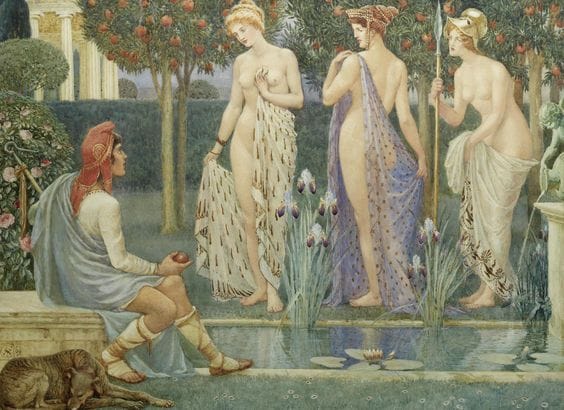
Interlude to the Interlude: The Judgment of Paris
At the wedding of the king Peleus and the goddess Thetis, every god is invited except one: Eris, who happens to be the goddess of Discord. Insulted, she appears anyway and, true to form, tosses a golden apple [3], onto the banquet table, inscribed “To the fairest.”
Hera (Zeus’ wife and queen of the gods), Athena (Zeus’ daughter and goddess of wisdom and war), and Aphrodite (Zeus’s daughter [4] and goddess of love and beauty) all claim it. They demand that Zeus choose the rightful recipient. Preferring not to offend the goddesses, Zeus orders the mortal Paris, recently restored as a prince, to judge their beauty [5].
The goddesses resort to bribes to influence Paris in his choice:
- Hera promises political dominion: Paris would rule all of Asia
- Athena promises military glory: Paris would be unbeatable in war
- Aphrodite promises beauty incarnate: the love of Helen of Sparta, the most beautiful woman alive
Being the virile, libidinous young man that he is, Paris is overcome by his priapic passions, choosing desire over power or glory and awards the apple to Aphrodite, securing Helen of Sparta as his prize.
Paris Ignites War
Shortly thereafter, Paris is sent to Sparta as an ambassador of Troy. There he meets Helen, Queen of Sparta and wife of King Menelaus. Aphrodite delivers on her promise: Paris successfully seduces Helen during his stay in the Spartan court, and the two abscond to Troy while Menelaus is away in Crete attending his own father’s funeral.
Menelaus, incandescent with rage, calls upon the Greek kings to avenge the insult and retrieve Helen from Troy. Agamemnon, King of Mycenae (the largest of the Greek city states at the time) and brother of Menelaus, mobilizes the Greek states. A thousand ships and one-hundred thousand men sail across the Aegean to lay siege on Troy and recover the “abducted” Helen.
Thus begins the Trojan War.
The Judgement Endures

What continues to strike me about this myth is the absurdly disproportionate consequences of a seemingly innocuous social slight. A (discordant) goddess left off a guest list for a C-list wedding crashes the party; she tosses a golden apple onto the table; three divinities begin bickering over who is the fairest; a young Trojan prince, newly rediscovered, barely reinstated into the royal family, is drafted as judge. Seduced by beauty over dominion or glory, he awards the prize to Aphrodite. That choice leads to a diplomatic mission to Sparta, which leads to an elopement (or kidnapping, depending on your preferred spin), which leads to a Greek coalition one hundred thousand strong sailing across the Aegea. From there: the ten-year siege of Troy; the wanderings of Odysseus; the exile of Aeneas; and, in the Roman imagination, the founding lineage of Rome itself. A single moment of divine vanity becomes the first domino in Western epic.
Equally astonishing perhaps is the sheer longevity of the story. Nearly three thousand years later it’s as present as ever: circulating through literature, painting, sculpture, cinema, 10th grade literature courses, and, more modestly, depicted in a battered grisaille I found at les Puces. Indeed, a man in the 21st century wanders into les puces and buys a 19th century grisaille panel, originally commissioned to adorn a Neuilly-sur-Seine salon; that 19th century artist drawing on a myth revived by enlightenment scholars; those scholars relying on renaissance humanists; the humanists on medieval monastic copyist; the copyists on Roman scribes; those scribes on Hellenistic scholars; and those scholars on the poems first written down in the archaic period attributed to “Homer,” a name standing in for generations of 8th century BCE bards who were themselves inheriting fragments from even older Bronze Age myths. This is but an instance of the beauty of the classical tradition - that a flaking canvas from les puces can trace its lineage back through the medieval to the Byzantine to the Roman to the Hellenistic and finally (if you are so inclined to believe the stories) to a blind singer performing on an Anatolian shore is, to me, as remarkable as the story itself.
Lastly, I would be remiss to leave unacknowledged the unmistakable gender asymmetry present in the scene. It is effectively a primordial male gaze. Three goddesses - embodiments of wisdom, power, and beauty - stand before a man and compete for his approval, their worth hinging on his assessment of their pulchritude. Paris reclines and judges; they offer and petition. Divine power, intellect, and authority collapse into a beauty contest adjudicated by a mortal boy (who, depending on the reading, was still a shepherd at the time). How patronizing.
Perhaps it is the combination of all of these elements that keep the Judgement of Paris (and my canvas) relevant today. It is not merely a depiction of the myth that launched a thousand ships. It is a reminder of how stories survive and how small choices reverberate across millennia.
Isn’t it all just a bit absurd?
Addendum: What about the panel itself?
What we ultimately discovered is that the panel is a grisaille - a monochrome painting executed to imitate an antique bas-relief, composed in a long, horizontal procession that unfolds almost like a frieze. Apparently this decorative motif was quite fashionable in Paris in the early 19th century, adorning salons with “modern” reinterpretations of classical antiquity.
The canvas’s curious silver-gold patina is typical of aged grisaille. Originally painted in cool whites and grays, over two centuries the pigments oxidize, binders yellow, and varnishes darken, transforming a stone-like monochrome into the warm metallic tones that radiate off this canvas today. What began as a sober, neoclassical imitation of an antique relief now carries, perhaps accidentally, a glitzy proto-Art Deco quality.

And the resemblance is not incidental. The elongated, idealized bodies, the flowing drapery, the balanced frieze-like composition are precisely the classical motifs that Art Deco sculptors revived in the 1920s and 30s. The figures on my panel would not look out of place among the allegorical reliefs that greeted me years ago in the lobbies of Rockefeller Center, nor among the stylized friezes at the Trocadéro or the Hoover Dam. All belong to that modernist project of fusing classical prototypes with the power and confidence of the industrial age - a way of suggesting that the machine age was the rightful heir to antiquity, that the steel city was the new Athens, the new Rome, endowed with its own civic mythology.
Notes
[1] Appropriate enough given the Paris Olympics were to commence the following summer. Recall the Phrygian cap was the controversial mascot of the 2024 olympic games.
[2] The Anatolian one, not the Cretan one.
[3] It was actually a quince; Cf. the apple of the garden of eden, which is actually simply described as a fruit. These were not grouped as apples until medieval times.
[4] In some traditions she is described as a primordial goddess, born from the sea foam produced from Uranus’ severed genitals. Oof.
[5] In some tellings he hasn’t been restored yet as prince and he is still a shepherd at this point.